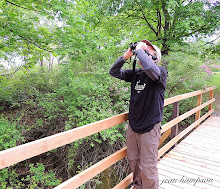
Jean and I had the Thanksgiving Day weekend pretty well set before it started. On the Saturday we would attend the OFO Hamilton/Burlington trip, assist John Black with the Fall Buffalo Ornithological Society (BOS) count on Sunday and relax and possibly do some yard work before going to my brother-in-law's for dinner on the holiday Monday. All it took was one e-mail and plans for Monday were suddenly changed.
It was Sunday evening when I became aware that there was a possible juvenile Purple Gallinule in St. Catharines. Not only was the marshbird within minutes of my home, it was near the area Jean and I had birded with our fellow Niagara birders earlier in the day. For part of the morning, we counted birds on the west pier and in Malcomson Eco Park in Port Weller for the BOS Fall count. At 10:00 AM, Jean and I left the group so we could start on our assigned area within John's section. The lucky few that stayed as a group would find a juvenile Purple Gallinule at a pond on the east pier in Port Weller while Jean and I were walking the trails in Firemen's Park.
An additional posting Monday morning had Jean and I heading for Port Weller for an early afternoon tick for our Ontario list. Our lifer Purple Gallinule was observed in the East River Pool at St. Marks NWR while on vacation in the panhandle of Florida in June of 2007. Though the breeding range of the Purple Gallinule reaches the gulf coast of the United States from the tropics, they do stray northward quite regularly.
Walking along the seaway road towards the pond, we met inquisitive dog walkers and birders that were successful in their hunt. We took the advice of the reports and headed for the east side of the pond, meeting additional birders, including Paula, a member of the group that observed the bird on Sunday morning. The bird was still there and had been seen standing on and near an object sticking out of the water. The juvenile gallinule was hidden when we arrived but it eventually made a short appearance before disappearing in the reeds.

A few more birders arrived, some choosing to pass on turkey dinner with their family so they could observe a tropical mashbird in southern Ontario. The bird was partially seen as it moved through the reeds. A few chose to try and observe it from the west side of the pond and were rewarded with great views. At first, I stood my ground on the east side with hopes that the gallinule would walk back to the object sticking out of the water. A birder from Oakville indicated he was seeing the gallinule quite easily, so Jean,myself and Hamilton birder, Cheryl Edgecombe, quickly walked over to the west side.

The wait was not long. The Purple Gallinule soon emerged from the Phragmites and cattails, allowing Jean and I excellent views of the reported bird. The lighting was significantly better on the west side and Jean took out her Nikon Coolpix and started snapping digiscoped images.

The gallinule repeatedly flashed its all-white undertail coverts. This was an important observation. If there was a sign of a black line in the undertail coverts, then we were looking at a Common Gallinule (formerly know as a Common Moorhen). Neither Jean or I could see any black in the undertail coverts.


The body of the bird was buffy-brown and there was hints of green on its back and wings. This was definitely a juvenile Purple Gallinule.

Number 257 for the Ontario list and number 204 for the year.

This will be the fourteenth observation of the species in Ontario and only the fourth in Niagara. The last record of Porphyrio martinica in Niagara was in October of 1962 (Black and Roy 2010).

As people left, more arrived. My cycling friend Dave (an occasional contributor of images to my blog) began snapping photos with his digital SLR as we helped him, Mike, and our fellow OFO members, Norm and Marilyn get on the bird. I wonder if we'll run into the same group of friends when we go see The Big Year?

During the 1.5 hours Jean and I were at the pond, we had some great unobstructed views of the Purple Gallinule. It certainly removed the sting of missing the observation during the BOS count. Filled with gallinule, we still had plenty of time to arrive at my brother-in-law's for Thanskgiving dinner and fill ourselves with turkey.