Showing posts with label Carden Alvar. Show all posts

Saturday, August 4, 2012

Scopeless in the Carden Alvar

Yes, it was after leaving our spotting scope for repairs to the mounting foot that Jean and I realized we would be scopeless during the OFO Carden Alvar trip. Viewing an endangered shrike hundreds of metres away could be difficult. No digiscoping either. 

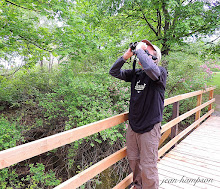
There were a few birders in the group that had scopes including trip leader Jean Iron. An excellent trip leader, Jean Iron always ensures that everyone in the group has observed the target bird before moving on. If a Loggerhead Shrike or Upland Sandpiper were too far for our bins, a view through Jean Iron's scope would be available. 

After participating in and winning the Carden Challenge over a 24 hour period from 6:00 p.m. on Friday May 25 to 6:00 p.m. on Saturday May 26, Jean Iron did not look tired at all. Perhaps, it was the Carden Cup on display atop her vehicle. Her team was named the Yellow Rails and the four birders ticked 132 species during the competition. As Celebrity Birder, Jean raised over $11,000 for stewardship and bird habitat conservation by The Couchiching Conservancy on the Carden Alvar. 


The first stop for the OFO group was Wylie Road. We walked along the narrow gravel road looking for grassland species and the Prairie Smoke was in full bloom.


Grasshopper Sparrow and Wilson's Snipe were added to the year list and we had the best look at a Loggerhead Shrike, ever! Jean and I have visited the Carden Alvar twice and all our views of shrikes have required a scope. This trip, a lone shrike was resting on a pole, a mere distance from the road.  It would have been nice to capture a digiscoped image though.

Continuing north on Wylie Road, we reached the Sedge Wren Marsh. We ticked our lifer Alder Flycatcher and Sedge Wren in May of 2010 at this spot and repeated the observation in 2011. This year, an Alder Flycatcher was heard singing but the rapid chatter of the small wren was absent. Marsh Wrens (FOY) were heard and spotted but due to beaver activity in the area and rising water levels, Sedge Wren was missed for the first time in many years.


While scanning the marsh west of the road, I heard the whinnying call of a Sora. Though we had our backs to the marsh east of the road and the call was short, a few of us were still able to identify it. I asked the fellow standing next to me if he heard the same call. He did. So did his wife and Jean as well. That was the important part. Jean confirming that she heard the Sora added the small rail to our year list.

At the Kirkfield Liftlock, a FOY Cedar Waxwing tick during our lunch. Once again, we have to travel north of Lake Ontario to obtain this species for the year list despite covering a number of spots in the Niagara Peninsula prior to this trip.

At the heron rookery on Shrike Road, we had an added bonus to the annual Blanding's Turtle observation. Great Horned Owl (FOY) had no objection to using a former home of a Great Blue Heron family to raise its own young. Jean expanded her digiscoping skills by using a scope she was unfamiliar with and managed to capture a decent image.


We moved further up Shrike Road and added Upland Sandpiper to the year list as a small flock flew past our group.

Approaching Canal Lake on Centennial Park Road, we added Green Heron and Great Crested Flycatcher to our year list and despite it being virtually identical to our first observation earlier in the day, we ticked our second Empidonax of the trip, a Willow Flycatcher.

As we crossed the causeway, I was looking for our streak of repeat species to continue. In 2011, the small pond on the island produced a lifer Least Bittern. An unobstructed view of this bird occurred after playback but this year, an inquisitive bittern did not emerge from behind the reeds.

The group ended the trip searching a few spots along Prospect Road. In the marsh, we observed a Virginia Rail in flight as it popped up from the reeds  There was a second rail close to the road but it remained well hidden.


There is a variety of habitat along this road including scrub. So after ticking waterfowl, flycatchers and rails you move a bit further south along Prospect Road to look for Emberizid species hiding in the brush. We stood at the edge of the road scanning the scrubby landscape for singing sparrows. OK, there's the Song Sparrow and a Chipping Sparrow but what Jean and I really needed was the appearance of a Clay-colored Sparrow. It did not take long for the group to pick out the insect-like buzz of a Clay-colored Sparrow. No visual observation this year but it still counts.

At the end of the trip, the year list stood at 183 species. Not bad if I want to succeed in beating last year's total of 216. There are some species that I cannot afford to miss and then there are few (not too many mind you) that I'm willing to let slip by. Missing Sedge Wren and Least Bittern would be be tolerated as long as the dependable ticks keep me ahead of the game. The month of June would be spent hitting spots in the Niagara Region for the reliable species until the migrating shorebirds arrived.


Monday, October 10, 2011

Alvar Birding

May 29

Alvars are a unique habitat found over a base of limestone or dolostone and are limited to areas in northern Europe and the Great Lakes Region of North America. Luckily for me, I live between two Great Lakes, which allows me easy access to an alvar that is designated an Important Birding Area by Birdlife International.

The Carden Alvar is located northeast of Toronto and can be easily reached in 2.5-3 hours from the Niagara Region. Last year's trip was the first visit for Jean and I and we added 5 lifers, including the endangered Loggerhead Shrike, to our life list. This year I was looking to add a number of species to the year list and if a couple of lifers were collected in the hunt, all the better.


We stayed overnight in Orillia and Saturday evening was spent birding along a paved trail that took us to the Narrows and a municipal park by Portage Bay. We added 16 species, ranging from the ubiquitous Rock Pigeon to a colourful male American Redstart, to the Simcoe County list. After ticking an Eastern Meadowlark on our way to Kirkfield the next morning, the county list stands at 31 species.


We met trip leaders Jean Iron and Ron Tozer in a Kirkfield school-yard and scanned for birds while waiting for the rest of the group to arrive.Though species were limited, Jean and I added Cedar Waxwing to the year list. You never know how many members will attend a field trip. The OFO Carden Alvar trip is a popular one but it appeared the forecasted rain discouraged quite a few from joining us for a great day of birding. There was certainly going to be a lot more elbow room along Wylie Road this year, our small party of birders was less than half the size of last year's trip.

A light rain was falling as we strolled north along the gravel road. If I didn't get my target species the first attempt, I could try again after birding the Sedge Wren Marsh.  Jean and I have found Grasshopper Sparrow and a surprise lifer Clay-colored Sparrow in the Niagara Region but these Emberizid ticks are more easily found in the grassland and scrubland of the Carden Alvar. Four species of Emberizid were singing as we walked along Wylie road and we had some good views of Grasshopper and Clay-colored Sparrows through the scope at Windmill Ranch.

An Upland Sandpiper stood atop a lichen encrusted rock.


Before reaching the marsh, we ticked two more firsts of the year, Brown Thrasher and Golden-winged Warbler. Like last year, the male Vermivora chrysoptera was seen singing from an open perch.

Once in the Sedge Wren Marsh we listened for the calls of wrens, bitterns, sora, rails and flycatchers. Last year, we observed a lifer Alder Flycatcher and Sedge Wren and ticked American Bittern and Marsh Wren for the 2010 provincial list. This year, these species were repeated. American Bittern were calling and we had a quick view of one flying low before it dropped out of sight. Sedge Wren and Marsh Wren were heard singing but stayed hidden and Jean Iron picked out the call of an Alder Flycatcher which we spotted perched on a branch. Without its call, it would just be an Empidonax sp. The wichity wichity wichity song of the Common Yellowthroat and the descending whinny of a Sora were also heard. As we left the marsh, one last FOY for Jean and I, a Black-billed Cuckoo. This species avoided my checklists last year and it just might help me get 208+ this year.

Returning along Wylie Road, we spotted additional Brown Thrasher and a Wilson's Snipe (FOY), a species missed in April during the OFO trip in Algonquin Provincial Park.

A few more Upland Sandpiper were found.


Including this one that Jean photographed from the car as we drove by the fence post.


No Loggerhead Shrikes were observed while hiking along Wylie Road but there was still the possibility of observing the masked endangered species during our visit to the Carden Alvar. At the Great Blue Heron rookery (seen from Shrike Road), we observed a rare Blanding's Turtle sunning itself on a log.


Travelling north towards McNamee Road, we stopped to scan the scrubland for shrike. Though it was distant, we got on a Loggerhead Shrike using the scope. We found a second Loggerhead Shrike and an Upland Sandpiper while scanning more scrubland on McNamee Road.

At the Cameron Ranch on Kirkfield Road 6, a third shrike for the day, Wilson's Snipe and Brown Thrasher.


In 2003, the Nature Conservancy of Canada acquired the Cameron Ranch and the 1161 hectare ( 2869 acres) property will become part of a new Carden Alvar Provincial Park.


We then crossed the causeway at Canal Lake and observed an Osprey in its nest on one of the platforms. No Common Loon in the small body of water near the causeway this year but a little further down Centennial Parkway, we stopped near the small marsh to look for bitterns and rails.


Jean Iron played the song of a Least Bittern and the coo coo coo brought out the inquisitive lifer (#307) for my wife and I. We studied the Least Bittern through our scope as it stood grasping a reed in each claw in order to support itself above the water. Once we had taken in all of the bittern's field markings, it was time to capture a digiscoped image of the very photogenic pose.


Yes, it bolted! The only photographic evidence we have is a small brown blob flying above the marsh.


We continued the trip south of Kawartha Road 48 to look for Sora, rails, bitterns, wrens and waterfowl in the Prospect Marsh.

In one section of the marsh, Jean and I ticked Blue-winged Teal and Pied-billed Grebe for the year list.


At our second stop, the spot where we observed our lifer Virginia Rail on our first visit to the Carden Alvar, we observed a Virginia Rail (FOY) and a Common Gallinule (FOY). The last time we observed a Gallinula sp in Ontario (April 2007), it was known as a Common Moorhen. This was a welcomed tick. It had been absent for 3 long years. Now, if I ever find myself in Europe, thanks to a split into Old World and New World species, I can once again add Common Moorhen to my life list.

Further down Prospect Road, the group found Clay-colored Sparrow sitting low in the scrubby brush and we had some great views of a second Virginia Rail.


The trip was nearing completion when Jean and I ticked one more first of the year. This time, the call of a Empidonax species belonged to a Willow Flycatcher.

After a day of birding in the Carden Alvar, 20 species were added to the Ontario year list and another month of birding came to a close. Ticking a lifer Least Bittern, Common Moor, errr I mean, Common Gallinule, both the Alder and Willow Flycatcher as well as the target species will certainly help to obtain a second 200+ year. The next few weeks would be considerably slower and that was OK with me. Before heading up to Sudbury in July for a chance to tick warblers missed during their migration through Niagara, Jean and I would do some Marsh Monitoring in St. Catharines.


Monday, June 7, 2010

Shrikes, Spares and Misses

Northeast of Toronto is an Important Bird Area (IBA) filled with grassland and scrubland species that attract birders from across Ontario. Birding is best in late May and June and for our first visit to the Carden Alvar, Jean and I attended the OFO trip on May 30.


For more information on the Carden Alvar check out Ron Pittaway's excellent birding guide found on the OFO site. Ron also wrote the Hot Spots Near You article for the Carden Alvar in Birder's World Magazine.

Jean and I travelled to Orillia (less than an hour west of Kirkfield) the day before to avoid a 2.5-3 hour early morning drive. Saturday evening we explored the area east of Lake Simcoe and found an Osprey nest atop a utility pole. Little did we know that we would encounter quite a few more the following day.


The group met in Kirkfield for the OFO trip led by Jean Iron. Assisting Jean on the day were Ron Pittaway, Ron Tozer and Eleanor Beagan. Wylie Road was our first stop and Ron Pittaway describes it as "the best early summer birding road in southern Ontario".

While parking the car I immediately noticed the Poison Ivy along the roadside. Where the side of the gravel road ends and the green vegetation starts, the three leaved plant is quite common. When looking at a lifer bird, pay attention to the location of your feet.

The group walked north along Wylie Road and I easily ticked 3 species of blackbird which include our first grassland species of the day, Bobolink.


The purplish hues in the field are that of the wild flower Prairie Smoke. The alvar provides the environment required for the prairie species to grow.


Not too long into the hike Jean and I ticked our first spare (addition to the year list) of the trip. An Upland Sandpiper was spotted on a fence post along the east side of Wylie Road. Soon after, Ron Tozer's discussion of the nesting boxes along the road was interrupted by one of the target birds. Shrike! It was distant but Jean and I had some great views of our first lifer of the day through our scope. The Loggerhead Shrike entertained the group as it disappeared and reappeared moments later atop a new perch. In the same area, we observed our second spare of the day. A Brown Thrasher! This was a very worthy tick. Despite attempts at observing this species last year it was not added to the 2009 list. And then another spare. Grasshopper Sparrows (3) were spotted in a few locations along the road, including during our stop at the Windmill Ranch viewing area.

Further north along Wylie Road the scrub to our left became denser. A song that I never heard before was coming from this area. The trip leaders informed us that the bird singing was a Golden-winged Warbler. If I was able to get on it, I would have another lifer. Another birding couple knew Jean and I needed this species and quickly grabbed us when they had it in their scope. It was a rear view of the bird as it sat near the top of a tree so those of us observing the warbler could only see a yellow crown and what appeared to be a black ear patch. When Ron Tozer got on the bird he quickly informed all that it was a Chestnut-sided Warbler. The streaking on the back indicated that this was not the lifer bird we thought we had. All was not lost though. A Golden-winged Warbler was still singing somewhere in the scrub. This time, we would get on the right bird. A male Golden-winged Warbler in all his glory was on some bare branches and provided a great view for all.


Yes, black throat; black ear patch bordered in white; yellow crown and wing patch. This was definitely a Golden-winged Warbler! Lifer #295.

You can see that I could not contain my excitement after viewing the lifer warbler.


After walking 2.5 kilometres the group reached the Sedge Marsh. Wylie Road cuts through the marsh and continues north until it reaches Alvar Road. The marsh is a reliable spot for finding Sedge Wren. The first wren observed though was a Marsh Wren, another spare for the day. Another spare was ticked as 2 American Bitterns were observed flying low through the reeds west of Wylie Road. We soon had our third lifer of the day. A Sedge Wren was singing from the top of a bullrush. It would move to a bush but we still had great views of lifer #296.

Further up the road, Jean Iron picked out the call of an Alder Flycatcher. This would be another lifer if we found it. Not only did we find it (lifer #297) but Jean, "My Jean" (I call her when on trips lead by Jean Iron), was first to see it through her bins and describe its location to the trip leader. This was turning out to be a great day! Four lifers along one stretch of road. Ron Pittaway is right. This is a great rural road for birding! It was time to head back to the cars and stop for lunch at the Kirkfield Lift Lock.


After lunch we drove the cars to Shrike Road to observe a Great Blue Heron rookery. In the pond we found a rare Ontario species. It was not avian though. It was a Blanding's Turtle. A lifer reptile!


We turned around on Shrike road and headed east along McNamme Road. As the line of cars was coming to a stop, Jean Iron flushed a Ruffed Grouse, almost hitting it. Most of the group would not observe the spooked bird. A miss for Jean and I. The group scanned the fields south of the road for more target birds. Upland Sandpiper (2) were seen and another distant Loggerhead Shrike. Great to see that there may be 2 nesting pairs in the area.

Our next stop was at the causeway on Canal Lake. Here we found 2 pairs of nesting Osprey at both ends of the causeway. While stopped at the north side of Canal Lake we observed a few gulls (Herring and Ring-billed) and a Common Loon. Two more loons (a pair) were observed on the south side of Canal Lake.

From Canal Lake the group headed south to Prospect Road. The road runs south from Kawartha Road 48 and takes you through Prospect Marsh. We stopped at the marsh to search for bitterns, rails and wrens. Marsh Wrens were popping up out of the reeds and singing from the top of bullrushes. A favourite perch I assume.


Both Virginia Rail and Sora were calling but were well hidden from the group's view. OK. This is where counting a bird gets tricky. At least for me. A Virginia Rail is a lifer so it also needs to be seen by both Jean and I to be added to our lists. We had only observed Sora twice before this trip. As you can see, we have not seen many Sora at all. Should I count the Sora calling in Prospect Marsh? Ron Tozer brought his "old school" tape player and played recordings of both the Virginia Rail and Sora calls. This caused some movement in the reeds behind the group (west side of the road). A member of the group finally observed the bird as it quickly moved through the reeds. Patience paid off and both Jean and I were able to observe our 5th lifer of the day as it ran between clumps of reeds. Virginia Rail! Lifer #298. The Sora continued to call from the marsh on the east side of the narrow road. At times it was right in front of me but not one of us could get on it. Jean decided we should count the Sora and I totally agreed. It was less than 2 metres from us while calling. Another spare in the Carden Alvar.

Our last stop was further south on Prospect Road. Stopping in an area filled with scrub we searched the field, listening to a song Jean and I heard for the first time two weeks ago. Our last observation of the day was a Clay-colored Sparrow.

A great day was had by all. Jean and I observed a total of 48 species in the Carden Alvar. Considerably less than the number (75 species) tallied by Ron. If only one member of the group sees a bird it is still added to the trip list. As you can see there were some misses.

A Black-billed Cuckoo was only seen by Ron and one other OFO member while we were at the causeway. It flew away before Ron could attract the attention of the rest of the group. Another bird missed by Jean and I was an Eastern Towhee on Wylie Road. Hopefully we can tick one while birding in the Niagara Region.

In total, 12 species were added to our year list. 3 misses, 12 spares and 5 lifers. A great day of birding which might not be matched for quite some time. This trip may become an annual one. It should if I want to continue a 200+ species list every year. Of course I still have to accomplish that for the first time this year. There are a number of shorebirds that still need to be ticked. Looks like the next OFO trip we will attend will be at Rock Point in August. Perhaps a Baird's or Buff-breasted Sandpiper will be our 300th lifer. I think I can wait though. I really don't want June and July to go by that fast.