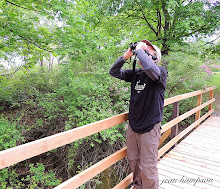
A little bit of gull watching the day before the MNR mid-winter waterfowl count. It's nice to tick gull species this early in the year, especially when it's 7 degrees Celsius in January.
At Adam Beck, in the swirl of Herring Gulls, we spotted a second winter Lesser Black-backed Gull and an adult Iceland Gull. We found a second Iceland (juvenile) standing on the rocks near the Robert Moses Niagara Power Plant. As expected, the smaller Bonaparte's were moving up and down the river and we found fewer than usual at the Whirlpool. No kittiwake as I had hoped and no Little Gull either. I think I'll attempt to spot the black underside of a Little Gull's wings in April. Standing at the side of the Niagara River in NOTL as thousands of Bonaparte's Gulls bound for Lake Ontario fly by is sure to produce one or two Little Gulls. Last time we did that, it took less than 60 minutes.
Other gulls still needed for the 2012 list (and ticked last year), Glaucous, Thayer's, and Franklin's. I expect the Franklin's Gull to be a difficult tick.
January 8
Since 2009, Jean and I have assisted with the duck count. This year, the weather was cooperative. Sunny skies and bearable temperatures made for a pleasant day. We were covering the southern shoreline of Lake Ontario from Fifty Point in Grimsby to Vineland.
Our first stop was at the end of Fifty Road. A fitting place to tick our 50th species of the year. Approximately 10 White-winged Scoter were found with the 100 or so Long-tailed Ducks. Numbers of both species would increase greatly as we moved eastward.

At Fifty Point Conservation Area, Greater Scaup (300), Long-tailed Duck (300), Common Goldeneye (100), some White-winged Scoters and one Black Scoter (that's all you need for a FOY tick) were seen on the lake.
After counting waterfowl in the marina, we turned our attention to non-waterfowl species, specifically owls. We were looking for Northern Saw-whet Owl. In winter, the small owl can be found roosting in small evergreens. We spread out and began our search for evidence of white "wash" on the trunks of the pine trees. A Long-eared Owl was flushed and I had a quick glimpse of it as it flew away and disappeared behind a tree. Jean and few others in our group were elsewhere and did not get a chance to see the slender owl with long wings. We started to regroup for a chance at a better look at the Long-eared when a member of the group called out that they had found our target species. If not for the telltale white "wash" on the trunk of a pine, we would not have seen the well hidden Northern Saw-whet Owl sitting on a branch close to the trunk, approximately 4 metres above the ground. In order to see our first lifer of 2012, Jean and I had to step back from the tree until we could view it through a mess of branches. Continuing our walk through this area, the Long-eared Owl was flushed again and we all had views of it in flight. Now that both Jean and I had seen the owl, it could be added to our year list.
Returning to the primary reason for being outside on this day, we moved on and observed over 500 Long-tailed Ducks east of Fifty Point. We also found an immature Surf Scoter at this location. No worries in December for Jean and I. All three species of scoter were safely ticked in early January.
In a Grimsby subdivision, we stood at the dead-end of a road and viewed thousands of Long-tailed Ducks and White-winged Scoters. The spot was new and I'll have to remember it for future use when a scoter species tick is still required for the year list.
At Grimsby Harbour, we were counting the Mallards and Canada Geese when a white blob on the east side of Forty Mile Creek caught the attention of a member of our group.

It's shape was similar to a stone marker, but this one moved.

It was a Snowy Owl. Unbelievable! Jean and I did not see any owl species in 2011 and now, in less than an hour, we had three species on the 2012 list.

A quick stop at a nearby marina confirmed our group's suspicions that it was a Cackling Goose they had seen with some Canada Geese on Forty Mile Creek.

Once considered the same species, Cackling Geese are nearly identical but are considerably smaller than Canada Geese. We were very close to this one and its small, stubby bill was viewed without any difficulty.


Belted Kingfisher was another FOY tick during the short time spent at the marina. Moving on to Beamsville, we found 3 Horned Grebes (FOY) and a rapid decline in the number of waterfowl. This is most likely due to the distribution of zebra mussels. The mollusk is an invasive species in the Great Lakes and despite the large number of scoters and other diving ducks feeding on them, the mussel from the Caspian Sea is a major problem in North American freshwater lakes.
Our count concluded after checking a few more locations between Beamsville and Vineland that had public access to the lake. We were in contact with Kayo during the morning count (he always covers the shoreline from Port Weller East to NOTL) and he had observed the reported King Eider in the Welland Canal. A quick call confirmed that the diving sea duck was still present in the canal and Kayo was willing to wait for our arrival to lead us to the spot it was last seen. With our car leading the way, we zipped down the QEW and within 15-20 minutes I was walking down the gravel path, with a scope on my shoulder, all set to view the eider missed on January 1.
We only had to walk 100 metres down the path to start scanning the hundreds of Common Mergansers and it was not long before Jean and I were studying the eider through our scope. We have seen a female King Eider (our only observation) and after 6 years of birding, we were finally looking at a male King Eider.

It was quite the regal bird. The bluish-grey cap and nape, greenish cheek, bright orange-red knob and brilliant beak were all vibrant.

Excellent views of the rare winter visitor to Niagara.

Pocketing all three species of scoter, finding three species of owl (including a lifer Northern Saw-whet) in less than 60 minutes, ticking Cackling Goose (not seen in 2011) and a royal viewing of a male King Eider made for one excellent day of birding.
Though there are still more than 340 days left in 2012, it's going to be tough to top this one.