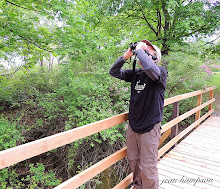
Approaching the pedestrian gate we heard the familiar Oh-sweet-Canada-Canada-Canada of a White-throated Sparrow. We had heard this species the previous weekend during an OFO trip but had yet to observe the bird. In little time, Jean and I spotted the bright white throat and yellow lore of the singing sparrow.
Northern Cardinals were very active, flying back and forth across our path as we walked the trail on the east side of the park. A Carolina Wren was quite vocal and at times making an appearance in the brush.
The first warbler we would come across, and there were many of this species, was a Yellow-rumped Warbler.
An Eastern Towhee (#112) would surprise us emerging from the brush onto the path.

Other warblers viewed during our first visit included, Yellow (#108), Palm (#109), Nashville (#110) and Black-and-white (#113).
Additional birds seen included, Canada Goose, Turkey Vulture, Killdeer, Hairy Woodpecker, Northern Flicker, Blue Jay, Tree Swallow, Black-capped Chickadee, House Wren (#111), Ruby-crowned Kinglet, Blue-gray Gnatcatcher (#114), American Robin, Chipping Sparrow, Red-winged Blackbird, Common Grackle, Baltimore Oriole (#116), American Goldfinch and House Sparrow.
A total of 30 species.
May 8
Jean and I had only been at the ecopark for a few minutes and were enjoying the view of a singing Black-and-white Warbler when Kayo walked in with his friend Brian and asked if we would join them for a morning of birding. With their experience and our younger ears it was sure to be a good day for all.
As we walked along the east trail, we observed Palm, Yellow-rumped and Yellow Warblers. Another birder on his way out informed us all of a Blue-winged Warbler further up the trail. Hey, that was the around the same spot we saw one last year while birding with Kayo, John and Katherine. We would arrive at the spot but could not see or hear the Blue-winged. We cut through a forested section and Kayo flushed a Gray Catbird for Jean and I (#125 for the year list). We would emerge from the forest onto a maintained trail on the west side of the park.

We remained in the forested section of the park and crossed back over towards the pond located on the east side. As we approached the pond, Jean and I heard the "bee-buzz"of a Blue-winged Warbler. Kayo and Brian unfortunately cannot hear this call. It was up to Jean and I to pinpoint the location. The four of us surrounded the area, a "T" intersection of two trails, and our patience would pay off. We spotted a male Blue-winged Warbler (#127).
Additional warblers observed in the park included, Black-throated Green, Nashville and Magnolia (#128). In the same area we spotted these warblers we also found Warbling Vireo (#124) and Blue-headed Vireo (#126).
Other birds not observed previously, Downy Woodpecker, American Crow, Rose-breasted Grosbeak (pair), and Brown-headed Cowbird.
A total of 34 species this day.
May 16
It rained heavily before we arrived for another morning of birding in the ecopark. Jean and I would meet Katherine and her friend as they were leaving. Katherine informed us that they had observed 17 species of warbler, including a beautiful male Cape May. Could we match Katherine's tally? She has an excellent ear for warblers.
 Jean and I would observe 10 species of warbler, 4 of which were added to the year list, Chestnut-sided (#135), Bay-breasted (#136), American Redstart (#137), and Blackburnian (#138).
Total species this day, 37.
May 23
It would be late in the morning when we started birding our last visit in May. We came across a plant with rather large leaves. No wonder an undetermined species of butterfly laid its eggs here. It couldn't miss.

Warblers were few and far between. Yellow Warblers were in their usual spot on the east side trail. Further searching produced only 1 Magnolia and 1 female Black-throated Blue (we have only seen females of this species so far this year). It was beginning to look like no other warblers would be observed and most likely a Spring without a lifer warbler. It is only our fourth year of birding and we still need to add a few warblers to the life list. Nearing the exit of the park I caught some movement in the weeping branches of a Willow, next to the path that connects the east and west trails. Another Warbling Vireo for the day. But wait. There was another bird. A male Black Poll Warbler, lifer #147.
Only 27 species observed during our last visit but the stunning Blackpoll lifer made up for the disappearance of warbler species.
With Spring migration concluded, it was time to prepare myself for some western birding. As this post spent quite some time stewing as a draft, we already know how the B.C. trip went.
Let's hope the warblers put on a great show in May this year, with perhaps, a lifer amongst them.


White-winged Scoter flew in from the west but would not commit to landing on the lake. We continued on, checking out the marina and the Niagara River at Navy Hall but no birds were seen. Our next stop was at Adam Beck.
Unlike the OFO Niagara River Gull Watch in 2009, few gulls were standing on the rocks on the U.S. shoreline in the gorge below. The Herring Gulls preferred flying between the generating stations. It must have been lunch time for them all. A small group of the gulls that we spotted standing on the edge of the river had no black in their wings. We counted 6 Iceland Gulls in total but we suspect there were more.
We were running short on time. The Whirlpool with its hundreds of Bonaparte's and 1-2 Little Gulls would have to wait until next weekend. We had to get to Welland in order to purchase some hot chocolate. Not just any hot chocolate but Hot Chocolate for Haiti. Our niece wanted to do her part in raising funds to aid the citizens of Haiti. Her idea of selling hot chocolate at the ice skating pond in a nearby city park was brilliant. She raised over $300!

Heading home Jean and I checked out some feeders we first discovered in December. Only Black-capped Chickadee at the first feeder. On Christmas Day this feeder was very active (Tufted Titmouse and Wild Turkey). Stopping at Short Hills Provincial Park we searched the area surrounding the parking lot and walked a short section of a trail. Nothing new until one last search near the parking lot. A Cooper's Hawk chased a smaller bird into the brush but emerged without any prey. At the other yard with feeders, we found our first House Finch of the year.
I thought our day of observations was done but on the way to my parents' for dinner we spotted at least a dozen Wild Turkey at the side of the highway. The male in charge of the flock was displaying very proudly. We have seen turkey here before so I always look to my right with hopes of observing the flock.
The Wild Turkey was #45 for my January Regional list. Only 5 more species and Jean and I will have a new record number of birds observed in the Niagara Region during the first month of the year. Next weekend will be our last chance to reach 50 species. Areas we visit will be determined by what species we still need and how easy it will be to observe them. As I sit here and think it over, it just might be possible.


After ticking a lifer Eastern Screech Owl in January, the hooting theme continued in February. A Short-eared Owl was added to the life list and in a matter of 24 hours, a trio of Great Horned Owls became a lifer Long-eared and 2 Short-eared.
The following week, the weekend was spent participating in the Great Backyard Bird Count.
The addition of a 5th owl species (all in a neat, tidy row) to our provincial list occurred in early April.
In May, I told of our trip to Algonquin Provincial Park which occurred the last weekend of April. The OFO trip on the Saturday produced 3 lifers and on Sunday, a revisit to the park delivered a fourth lifer on the Spruce Bog Boardwalk.
Rather than attend the SCCC Tuesday training ride, I chose to chase down a reported vagrant. Much easier than chasing a breakaway.
June was an exciting month. A week's vacation in beautiful British Columbia.

For three weeks in July, I was glued to the television screen viewing the Tour de France with commentary by twitcher Phil Liggett.
In search of a Brown Thrasher for the year list (we never did find one in 2009), we ticked a lifer Yellow-bellied Flycatcher.

Image courtesy of Frank Hampson Sr.
November was an exciting month for lifers in Ontario. While at the St. Catharines Spit, we ticked lifer #287. To tick the second lifer, we drove to a residential neighbourhood north of Toronto. We had some great views of the south-western visitor. I fear he may have finally succumbed to the below freezing temperatures.
We attended the last OFO trip for 2009 at the end of the month and shared lifers with our carpooling friend from Long Point.December began with a new winter list. I'm still hoping to beat last year's total of 71 species. But what would the month be without a Christmas Bird Count or two.