Friday, June 4, 2010

On the Road to 200

After adding 14 species to the provincial year list during two days of birding in Algonquin, it was back to looking for first of the years in the Niagara Region.


April 21

Along our favourite stretch of rural road, Jean and I searched for grassland species in west St. Catharines. We soon spotted a Savannah Sparrow after hearing its distinctive call.


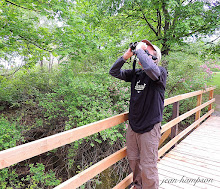
No. Jean is not checking on the progress of the new regional hospital. We found 2 Eastern Meadowlark in the field north of the road.


No Bobolink yet and unfortunately no Upland Sandpiper either. The Bobolink should return to the area in another couple of weeks.

We then went to the Merritt Trail to look for the Red-headed Woodpecker. The bird remained out of our sight but we added Wood Duck and Yellow-rumped Warbler to the year list. Yes, warbler migration has started.


April 22

What better way to celebrate Earth Day than with a morning of birding. At the eco park near Lake Ontario we searched for early migrants. Yellow-rumped Warblers (they usually are the first observed) were flitting in the trees. A Caspian Tern flying above the Welland Canal was the only first of the year this fine morning.

In the evening we visited the Green Ribbon Trail with hopes of ticking Fox Sparrow. Earlier attempts in the month of April came up empty. For the last three years we have found this spring migrant on the paved trail that crosses Martindale Pond. No spring sightings of the "Red" Fox Sparrow this year. We'll have to wait for the sparrow's return in the fall.

April 23

We returned to 5th Avenue with Jean's dad and his partner Ruth. They were eager to view the meadowlarks. Horned Lark and Savannah Sparrow were observed but the meadowlarks could not be found. On to Mud Bridge for a possible early, first of the year Cliff Swallow. Jean and I observed our lifer Cliff Swallow at this location in early June last year. Though none were seen this day we will return at a later date for a first of the year tick.

May 1

Chimney Swifts have returned to our neighbourhood. I observed one lone swift as it chattered and flew above our yard. Last year Jean and I counted the swifts for the Bird Studies Canada Chimney Swift monitoring program as they entered the chimneys of the Lake Street Armoury. As of June 2 the numbers of swifts sighted from the yard has increased to six. If there is another watch this year, count us in.

May 2

Jean and I travelled south to the Port Colborne area to add Woodcock to the year list. In April of 2009 we observed 1 Woodcock while exploring property owned by a friend.

We visited Mud Lake Conservation Area first and added Blue-winged and Green-winged Teal to the year list.


While walking along the trail above the man-made lake we observed a Yellow Warbler.

No Woodcock this year while visiting our friend's property but we added Spotted Sandpiper and Common Yellowthroat to the 2010 list.


May 6

A casual observation on the way to work added Baltimore Oriole to the list.


May 8

While birding in the eco park during spring migration you are guaranteed to run into fellow birders. This was our first visit during the month of May and our birding friend Katherine arrived as we were scanning the trees for warblers. Katherine has a great ear for birds and with the three of us working together we were able to get on some good birds. Warblers spotted included, Black and White, Black-throated Green, Blackburnian and Cape May. This was the first time Jean and I observed a Cape May Warbler in the spring. It is a beautiful bird! There are several trails in the park and Katherine went one way while Jean and I headed over to the west side of the park where we found 5 Rose-breasted Grosbeak (3 males and 2 females) feeding on the blossoms of an apple tree. Running into Katherine again I returned the favour and told her where she could observe the flock of grosbeaks.

May 9


After visiting the lilac gardens on the Niagara Parkway we had great views of an American Redstart during a Mother's Day walk with my parents at Dufferin Islands.


Over the 2.5 week period Jean and I observed 18 first of the years but we are behind last year's pace by 11 species. We have some birding to do. Our next big day of birding was a great asset in adding birds to the year list. On May 16 we assisted with the Buffalo Ornithological Society May count and before Jean and I started counting in our assigned area, we had great views of LIFER #292. You'll have to wait for the next post for that one. It's an epic one!


Thursday, May 27, 2010

An Inevitable Decision

On the Algonquin trip in April, Jean and I added Evening Grosbeak to the life list but we did not inch any closer to our 300th lifer. We remain at 291 species. As I added one bird to the life list, another was removed.

The bird in question was a Barnacle Goose. In field guides it is noted that numerous sightings from eastern North America are most likely escapes, especially if they are found inland. So the possibilities of a Barnacle Goose flying down the St. Lawrence River and coming to a stop on the southern shore of Lake Ontario were slim to none.

We observed the Barnacle Goose on Boxing Day last year and if there was the slightest chance of being an acceptable bird I added the goose to my eBird lists. There it would remain until the Ontario Birds Record Committee (OBRC) determined the bird's status.


During the Algonquin trip I was able to make a final decision on the Boxing Day Barnacle. Not only is retired park naturalist Ron Tozer an OFO trip leader, he is also a member of the OBRC. While on lunch at the park's visitor centre I asked Ron about the Grimsby Barnacle Goose. The bird has been observed in the Grimsby area for a few years and was rejected by the OBRC.

Now I am not one to judge nor was Ron for that matter. If a birder wishes to keep this Barnacle Goose on their life list that is their choice to make. It's their list and they can maintain it as they please. I have chosen to only count birds that are wild. If I did count escapees not only would the Barnacle Goose be on my list, I would also have an Asian bird commonly found in India on the list. A group of us observed a White-eared Bulbul at Rock Point Provincial Park during the 2007 OFO field trip.

With the life list still sitting at 291 it will be interesting to see if I can reach 300 before the end of the year. That may actually be easier than observing 200 species in Ontario. Looks like another OFO field trip is in order.

Wednesday, May 12, 2010

Algonquin Birding Part II

April 19


The day after the OFO Algonquin trip, Jean and I returned to Algonquin Provincial Park for another day of birding. We had the week off so there was no need to rush home.

Thanks to worthwhile tip provided by Ron Tozer during Sunday's field trip, Jean and I would make a stop near Oxtongue Lake before entering the provincial park. Ron informed me that the lifer bird Jean and I sought was producing reliable views at the feeders on the property of the Algonquin Inn.

We arrived at the front entrance to the inn around 9:00 AM. The restaurant was closed but the activity around the large number of feeders was buzzing. We saw no sign of the owners so Jean and I stood in the front parking lot taking in the views of the birds as they visited the nearby feeders.


American Goldfinch, Dark-eyed Junco, Purple Finch and Black-capped Chickadee were observed.


Within minutes of arriving we spotted our first lifer of 2010. I was positive I observed a male of the species fly across Highway 60 and disappear into a stand of conifers. Sure enough, I was not seeing things. Three Evening Grosbeaks (2 males and 1 female) were found in a birch tree on the east side of the restaurant. We had some great views despite them being uncooperative for a digiscoped image.


The owner of the Algonquin Inn returned from birding in the park and allowed Jean and access to the back of the property. We were hoping for a Rusty Blackbird but no matter how hard we tried all we could find were Red-winged and Common Grackles among the many blackbirds. In the conifers lining the laneway we spotted a pair of Yellow-bellied Sapsuckers.

If you're planning on visiting Algonquin, stop at the Algonquin Inn along the way. Gary and Tina are birder friendly (there are over 30 feeders on their property) and they provide updates and sightings on their blog, Algonquin Inn Nature and Photography Blog.

Upon returning home from our Algonquin trip, I found Gary commented on my Love of Birds-Video posting while Jean and I were on the OFO trip. This was before we even met him. Unreal! Gary read that I was hoping for a lifer Evening Grosbeak and in his comments he informed me that Evening Grosbeaks were showing everyday and that we should drop in on the way to the park. Well Gary,though I did not see your helpful advice until later, thanks for the tip and for the access to the inn's property. If we return for next year's OFO trip, Jean and I will definitely stop by to tick Evening Grosbeak for the 2011 provincial list. Keep listing the wildlife sightings!

On to Algonquin Provincial Park in search of Boreal Chickadee missed during the field trip.

At Tea Lake Dam road we ran into the Ohio couple that were on Sunday's OFO field trip. You don't have to be from Ontario to be a member of the OFO. We discussed birds seen so far before continuing on to Tea Lake where Jean and I were treated to views of a Common Loon above the dam.


We spotted Wilson's Snipe once again at Cache Lake but hiking the 1.5 kilometre trail at the Spruce Bog Boardwalk came up empty for Boreal Chickadee. None to be found along Opeongo Road either. Looks like a year without Boreal Chickadee. Seeing the brown-capped chickadee would have made the goal to reach 200 species a little easier.

During our stay in northern Ontario, we added 13 birds to the year list, ticked 3 out 4 of our Boreal species and added Evening Grosbeak to the life list. The life list did not grow though. It still remains at 291 species. Which species was removed you ask? One that was always in question and after a discussion with Ron, I made the inevitable decision to remove it from the list. The reasons for the decision to be discussed on the next post.


Wednesday, May 5, 2010

Feather Muster

Just when you thought the Leamington area could not get any crazier during a May weekend, birders with a competitive edge will not only be visiting Point Pelee looking for an elusive warbler species to add to their list but they will also be competing in the first annual feathermuster from May 15 to May 16.

The competitive count will start at the Hillman Marsh in Leamington at noon, Saturday May 15. Teams of 2-6 birders will have until noon the following day to spot and record as many species within their vision inside the boundaries of the count area. Teams must cross the finish line by 12:00 noon at Pelee Island Winery in Kingsville, Ontario. A very appropriate finishing line if I do say so myself.

Jean's quick spotting abilities and my ability to count and chew gum at the same time will be needed for the Buffalo Ornithological Society (BOS) May count on the 16th so any thoughts of entering will have to be set aside for a future feathermuster. But before I even think of entering such a thing, I should visit Point Pelee during a weekend in May (there's no way I can get time off from work during this month) just to experience spring migration in one of Canada's world-class birding sites. Yes, as I have stated before, this Ontario birder has never been to Point Pelee National Park during the month of May! This year you'll most likely find me walking the gravel paths (no ticks) of a local hot spot searching for a lifer warbler.

To any birders I know that plan on entering the challenge, I wish them the best of luck in their endeavours to earn a spot on the podium.

On a final note. A flock of _____ is known as a "muster".

Sunday, May 2, 2010

Algonquin Birding

April 18


The weekend of April 17, Jean and I travelled north for some birding outside of the Niagara Region. The destination, our favourite provincial park to attend the annual OFO trip led by retired park naturalist Ron Tozer. During last year's trip we added 4 birds to the life list which included 3 sought after Boreal species. This year, I was hoping to add the same species to the 2010 provincial list to reach my goal of 200 birds. If I was to tick a lifer, all the better.
Algonquin Provincial Park is approximately 4 hours from St. Catharines so a day trip would be highly unproductive. We spent the weekend in Huntsville, a mere 30 minutes away from Ontario's oldest provincial park.

As planned, we met at the west gate of the park and like all birders, scanned the area for avian activity while waiting for the trip leader. Ron arrived with his daughter Laura (a former park warden) and discussed the hot spots we would visit along the Highway 60 corridor. There are many hiking trails and campsites along the 56 kilometre corridor (marked with kilometre markers indicating the distance from the West Gate) and a handful of them were included on the itinerary.

Our first stop was at Kilometre 8 to check the utility poles for Black-backed Woodpecker. No woodpeckers but Winter Wren (2) were heard calling as we walked along the shoulder of Highway 60. On Tea Lake Dam road, we heard an Eastern Phoebe calling and spotted an Osprey overhead. Great! Three species added to the year list.

En route to our next stop, Jean and I observed our first Common Raven of the year. I sometimes think it may be difficult identifying this member of the Family Corvidae but the raven's large size and wedge shape tail leave little doubt that you are looking at a Common Raven. We picked up a helpful i.d. tip while vacationing with Jean's family in 2008. Jean and I (along with our nephew) attended a birding walk with a park naturalist at the Old Airfield and he informed the group that when American Crows land they flick their wings. Common Ravens, do not. Next time you see these two birds, watch them as they land in a tree top.

Our next stop was at the Cache Lake Marsh. Another tick for the year list. From the gravel shoulder, the group had a brief glimpse of a Wilson's Snipe as it landed in front of us and quickly took flight upon realizing it had an audience. While exploring the area, we observed Ruby-crowned Kinglet and had some great views of a beautiful, singing Blue-headed Vireo (another first for the year).

At the Lake of Two Rivers campground, we searched the pine trees for, you guessed it, Pine Warbler. Two males were setting up boundaries for their territories.


From the beach we looked eastward and spotted a Common Loon near the island in Lake of Two Rivers. Firsts of the year at every stop so far.


On to the Spruce Bog Trail for an observation of the star of the field trip. Last year we observed great displays from a male Spruce Grouse. Someone should have informed the male grouse he was wasting his time. The female, a "Franklin's" female, was mounted.

The OFO group spread out as we entered the Black Spruce west of the bog. It did not take long for an OFO member to spot a male Spruce Grouse. Playing recordings of a female grouse (a "Franklin's" female) did not elicit a response from the bird. The male continued on, oblivious to the photographers capturing its every movement.


Unlike last year, the fake female did not produce the courtship display. The male still appeared disinterested. Moments later, the Spruce Grouse performed a "flutter flight" onto a branch.


This differed from last year's display. The tail feathers were only slightly spread and the red combs erect. The reason for the courtship display was soon revealed. A real female Spruce Grouse.

At the Visitor Centre, Jean and I checked the feeders and added Purple Finch to the year list. Unfortunately, no Ruffed Grouse were observed this year.

After lunch the group travelled along Opeongo Road but could find no Boreal Chickadee in the Black Spruce. The road ends at Lake Opeongo and Ron led the group on foot to the Harkness Laboratory of Fisheries Research. A pair of falcons are nesting near the laboratory and as we arrived both a male and female Merlin were observed in flight. One of the pair landed in a distant tree and though instructions were exchanging between birders, it was still difficult to get on it when using the binoculars. Eventually all viewed the falcon as it sat in a swaying tree. Another tick for the year list!

We still needed Black-backed Woodpecker though. Last year, we found this Boreal species on a utility pole near the Leaf Lake Ski Trail. This was the group's next destination. The long line of cars followed the leader to the line of poles near kilometre 54. Our car was close to the back of the convoy and as we passed one of the utility poles Jean spotted the group's target bird.


I pulled the car over to the shoulder, well back of the car in front of us, while the cars behind continued on. I guess they did not see it or they just wanted to fill in the very large gap between the vehicles. Yes, there was at least 50 metres between us and the next car in the line. We waved to the OFO birders down the road and pointed at the utility pole with the Black-backed Woodpecker on it. While the rest of the group worked their way back on foot, I set up our spotting scope so Jean could start capturing digiscoped images of the male Black-backed Woodpecker. A birder from Buffalo jokingly said, "I assumed you were not pointing at the Great Blue Heron..." as he arrived to view the woodpecker and a couple of women stated Jean deserved a scotch for spotting the bird. All in the group had great views of the woodpecker as it continued to work on a hole it was excavating in the utility pole.

"Yeah, I think she'll be impressed with this one!"


We checked out the parking area of the nearby Logging Museum but came up empty for adding any birds to the day's list.

We had covered almost the entire length of the park's corridor so the group turned around and headed for the Old Airfield. Along the way, it was Laura's turn to spot a bird at the side of the road. A single Gray Jay near kilometre 40. As usual, when a long line of cars has stopped at the side of Highway 60, other park visitors assume there is a large mammal, preferably a moose, present.

Our group spent 30 minutes on foot exploring the Old Airfield and though we enjoyed the aerial display of a Northern Harrier there were no firsts of the year for Jean and I this time.


One last chance for Boreal Chickadee. The group hiked a section of the Mizzy Lake Trail. The trail is 11 kilometres long and a few years ago Jean and I set a day aside to hike the entire length while vacationing for a week at a resort outside of the park. The OFO group travelled up Arowhon Road to reach the old railway section of the trail. This turned out to be a long hike.
I estimate we walked 3.5 kilometres before turning around. It was worth it for some in the group. Though brief, some lucky birders had good views of 3 Boreal Chickadees. Unfortunately for Jean and I, the bird remained unticked on our year list. Black-capped Chickadee continued to appear in the open but the shy Boreal Chickadees did not reappear.

Walking back to our cars we came across two pairs of Gray Jays. One nesting pair along the old railway at West Rose Lake and a second pair near the chain gate along the old railway. The pair near the chain gate readily took food from Ron's and Laura's hands. As we approached our cars the Gray Jays followed us and continued to take any handouts offered, including some of Jean's trail mix.


A nice way to end a day of birding. Some in the group went on to search for Swamp Sparrow but Jean and I called it a day. It was close to 6:00 PM and the group had birded for over 8 hours. Jean and I were hungry so we thanked Ron and Laura for the great field trip and returned to Huntsville. At the Three Guys and a Stove restaurant (this may become a tradition) we discussed the birds observed and our plans for the Monday over an Algonquin Lager and a gin martini. Yes, we had another chance at finding Boreal Chickadee in our favourite provincial park and thanks to a tip from Ron, a possibility of a lifer along the way.


Sunday, April 25, 2010

Niagara Digiscoping


Belted Kingfisher, Ceryle alcyon
Dufferin Islands


Friday, April 23, 2010

Spring Count

April 11


Since 2008 Jean and I have assisted John Black with the local Christmas Bird Counts and MNR duck count. So when he called asking for our help with the Buffalo Ornithological Society (BOS) spring count we willingly accepted.

The BOS count (divided into sections) includes the Niagara Region in southern Ontario. As compiler of the section covering St. Catharines, Niagara-on-the-Lake (NOTL), Thorold and Niagara Falls, John assigned an area within the city of Niagara Falls to Jean and I. We covered the portion from Lyon's Creek Road/Main Street north to Steele Road/Portage Road and east of the Queen Elizabeth Way (a highway linking Toronto to Fort Erie, ON). Luckily the gulls at the Adam Beck Reservoir and along the Niagara River were counted by John and others. Hold that thought.

After looking over the maps and John's instructions, I thought it best we started along Lyon's Creek road south of the Welland River and work north towards the Niagara Escarpment. En route to Lyon's Creek Road we counted any birds spotted east of the QEW. Rural roads south of the Welland River were limited and did not take long to cover.


Starlings and American Robin were the majority in this area.

In Chippawa, we stopped at the boat ramp on the south side of the Welland River and at John's request, the bridge crossing the river and the feeders frequently visited by Niagara birders and members of the OFO on the Niagara River Gull Watch trip.


We walked under the bridge with hopes of ticking Barn Swallow. While under the west end of the bridge we observed nesting Rock Pigeon and mounds of their guano on the support beams. One Barn Swallow was spotted flying over the Welland River before it disappeared under the east side of the bridge.

The feeders were empty but still produced 15 species, including Yellow-bellied Sapsucker, Northern Flicker and White-breasted Nuthatch. Tufted Titmouse and Red-bellied Woodpecker usually found during our winter visits were not ticked this sunny spring day.

Heading along the Niagara Parkway, towards the Horseshoe Falls, we stopped at the Dufferin Islands Nature Area and walked along its trails before heading over to the engineerium to count the Black-crowned Night-Heron above the Falls. During the hour we surveyed the nature area, Jean and I observed a total of 25 species. Birds of interest included, Tree Swallow (4), Hermit Thrush (1) and Ruby-crowned Kinglet (1).


Our only concern above the Falls for the count was the Black-crowned Night-Heron roosting in the trees on the island behind the barge. Yes, a barge above Niagara Falls! Click on barge for the story on how it arrived to rest near the brink of the Horseshoe Falls.


Jean and I counted a total of 46 Black-crowned Night-Herons.


I also noted, first of the year, black-headed Bonaparte's Gull for my provincial year list. We would see plenty more later in the evening.


We passed Table Rock and tourists at the Horseshoe Falls as we continued along the parkway, adding any birds spotted on the manicured lawns of Queen Victoria Park to the day's count. The only area we checked in the urban centre was a cemetery. More Robins and Starlings.

North of the city, we stopped at the Niagara Parks Botanical Gardens. Spring flowers and blossoms were blooming and we observed 16 species, adding a second Belted Kingfisher and Ruby-crowned Kinglet to our checklist.


After travelling along a few more roads, we stopped at Firemen's Park on the Niagara Escarpment for one last count on foot. No new species but a third Belted Kingfisher and 2 more Ruby-crowned Kinglets were added to our checklist.

The day's count appeared to be finished. The only raptor observed was Northern Harrier (1). Quite surprising we did not observe any Red-tailed Hawk along the highway corridor (the hawk's favoured hunting ground) or the farm-land south of the Falls. As we approached the northern boundary of our area on the QEW, what did we spot soaring above the highway? Two Red-tailed Hawks heading eastward and eventually falling within our area. The last addition for the afternoon.

In the early evening, Jean and I drove to NOTL to count Bonaparte's Gulls leaving the Niagara River. Upon arriving at Nelson Park near the NOTL marina, we found two floats of Bonaparte's sitting on the river. I started to count the gulls resting on the river and Jean counted the gulls flying by to spend the night on Lake Ontario.

1, 2, 3, 4, 5....


500, 501, 502, 503....


After counting the gulls on the water, I turned my attention to the Bonaparte's in flight while Jean scanned the flocks for Little Gull (gulls with black on the under-wing).

2500, 2501, 2502...That's a really cool sailboat! 2503, 2504, 2505....


For a little more than an hour we counted the Bonaparte's Gulls flying by our vantage point.

4250, 4251, 4252....


Will it ever end?


Though the larger, fast moving flocks proved difficult to count at times (especially as the sunlight faded). Jean and I counted a total of 7000 Bonaparte's Gulls. What about Little Gulls you ask? There were a total of 3 Little Gulls. No need to worry about finding one at the Whirlpool during the OFO trip at the end of November this year.

We observed a total of 42 species during 8 hours of birding. For the entire section, Jean and I were the only birders that found Ruby-crowned Kinglet, Hermit Thrush, Barn Swallow and Northern Harrier.

8 hours of birding! You think that would be enough and there are no more counts until the CBCs in December. Well, we'll be covering the same area once again for the second BOS count in mid-May. We should get some good birds on that count. At that time of year, migrating warblers will be at their peak. Oh, and the Bonaparte's. No endless flocks for the next count. They'll be on their breeding grounds by then. Here's hoping for a 50+ species day.