Monday, November 15, 2010

Niagara Digiscoping: Port Weller East Pier

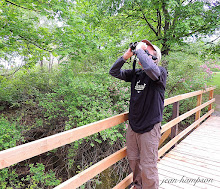
In early September, Jean and I hiked along the Waterfront Trail Extension on the Port Weller East Pier. In the smaller pond east of the trail and the Seaway Haulage Road we found a Green Heron.


Green Heron, Butorides virescens


Sunday, November 14, 2010

Not to be Outfoxed This Year

October 24


As some of you may know, Jean and I are attempting to tick 200 species in Ontario this year. Though not a Big Year (300+), 200 seemed a reasonable challenge for us to attempt. Currently, of the Top 100 eBirders in Ontario, only 25 have 200 or more species on their list. In 2009, we reached 197, a number we recently beat while on the Buffalo Ornithological Society Fall Count.


So the question in late October was, where to bird? During the 2008 OFO annual convention, Jean and I observed our lifer Pileated Woodpecker while walking through the Hendrie Valley in Burlington. It is a woodpecker species we have observed only once. With two full months of birding left, there was time for some long shots.

The Hendrie Valley Sanctuary covers 100 hectares and the property was transferred to the Royal Botanical Gardens (RBG) in 1941 for ecological protection.


It was a warm day in St. Catharines with the thermometer reaching a high of 18 degrees Celsius but as you travel through the Golden Horseshoe, the weather can change quickly. 30 minutes later, we arrived in Hamilton and the temperature dropped to 10 degrees. In addition to the cooler temperature, we were greeted by a thick mist as we crossed the Burlington Skyway.

At the Cherry Hill Gate (one of three entrances to the valley) we found a flock of Cedar Waxwings containing an anomalous individual. Its tail tip was red and not the standard yellow. The undertail coverts of this odd Bombycilla were white so it was not a Bohemian Waxwing. No other member of the flock had this unique field marking.


Descending the Grindstone Marshes Trail into the valley, we soon spotted our 199th species of the year with a few White-throated Sparrows.


Despite observing it three years in a row on the Green Ribbon Trail by Martindale Pond in Port Dalhousie, Jean and I missed the species this April. The eastern form of the species breeds in the Boreal Forest and winters in the southeastern United States so in southern Ontario it can only be observed during migration. Having missed it in the spring there was still a small window of opportunity to view it in the fall.


Fox Sparrow, Passerella iliaca #199 for the Ontario 2010 year list


In total, we observed 7 Fox Sparrows, all kicking backward with both feet in the leaf litter and gravel in search of food.


Before reaching Grindstone Creek, we spotted an immature male Common Yellowthroat and a Red-tailed Hawk standing watch over the south side of the valley.


We started our hike on the raised boardwalk and stopped to scan the valley for our red crested quarry.


In October of 2008, Lifer #243 was seen while looking east from the arched bridge.


No Pileated Woodpecker on this misty Fall day.


The Black-capped Chickadees were certainly not shy though.


As we walked downstream....


....we observed a muskrat and some Chinook Salmon in Grindstone Creek.


More chickadees willing to pose.


I will definitely not wait another two years before returning to the Hendrie Valley trail system. There are still a few trails to explore on the RBG property, one of which may just lead us to a Pileated Woodpecker observation.


The addition of Fox Sparrow to my lists did not end with the Hendrie Valley. Just over a week later, a bird with what appeared to be a streaked or spotted breast flew low across the yard. Though late, I was thinking, perhaps wishfully, that it was a Wood Thrush. Of course it was a Fox Sparrow, the 47th addition to the yard list. A bird that was truly in our yard. Jean and I watched the fall migrant for 15 minutes as it jumped around the gravel driveway. There had been no need to drive to Burlington the previous weekend. Will I be able to sit out back with a beer in hand waiting for #200 to show itself? I somehow doubt that a Surf Scoter or a Lesser Black-backed Gull will end up near downtown St. Catharines over the next few weeks or ever for that matter. Looks like a short drive to the Lake Ontario shoreline and the Niagara River are needed and the beer will have to stay in the fridge.


Wednesday, November 10, 2010

An Evening of Niagara Birds

Hey Western New York birders! If you love birding in the Niagara Region as much as I do, then you may want to attend an upcoming program at the Roger Tory Peterson Institute.

John Black, co-editor of Niagara Birds will be at the Roger Tory Peterson Institute in Jamestown, New York on Tuesday November 16 at 7:00PM. The special program requires no admission and is open to the public. Copies of Niagara Birds will be available for purchase the night of the talk.

Tuesday, November 9, 2010

Beak Abnormalities On The Rise

My cousin shared this CBC article with me earlier today.

The increase in avian keratin disorder amongst wild birds in Alaska and the Northwest is concerning. Hopefully, they can determine the cause sooner than later.

Friday, November 5, 2010

A Thankful Count Part II

October 10

During the Sunday of the Thanksgiving Day weekend, Jean and I participated in the Fall BOS count. Earlier in the morning, we birded as a group with a few fellow Niagara birders and successfully ticked Swamp Sparrow for the year list. We went our separate ways after birding the Port Weller east pier and Jean and I stopped at Firemen's Park to commence the count in our assigned area. The park is located on the Niagara Escarpment and I have many memories of visiting it on family hikes when I was a kid. Though urbanization has occurred to the southeast, the park looks the same.


The rolling landscape, large pond and trails (including the Bruce Trail) are still there and provide a habitat for a variety of birds. Wait, did I say rolling hills and trails? This would be a great spot for some cyclo-cross racing.


Image courtesy of Zoom Leisure Bikes


As we started our walk through Firemen's Park, Jean spotted a Yellow-rumped Warbler in the trees near the parking area. That would be it for wood warblers at this location. A large number of American Robins (40+) were seen throughout the park and while walking the forest trails north of the pond, we found another thrush species, 2 Hermit Thrushes. Wood Thrush remains off the year list and will most likely not be found this year.

Approaching an open area on the east side of the park, Jean observed movement in some Sumacs. It was a large Emberizid, a family that includes the towhees, sparrows, longspurs and Emberiza buntings. Upon observing the bird, Jean quietly called out, "Towhee!" "Towhee!". At first I could not get on the bird and I feared it would leave before I could tick it for the year list. This is a species we do not see too often and though it was heard during the Carden Alvar trip, we decided not to count the bird at that time. The Eastern Towhee jumped into view and I got some great looks at a male of the species, #198 for the Ontario year list, before it continued on its way through the brush. Woo hoo! New personal best for Jean and I. Other birds observed before we left the park included Carolina Wren, Northern Flicker and Eastern Phoebe.

The following Sunday, a day of cyclo-cross took place at Firemen's Park

Images courtesy of Zoom Leisure Bikes


Steve deBoer of Zoom Leisure Bikes set up the course.....

Images courtesy of Zoom Leisure Bikes


....and like the BOS FAll Count, it was a terrific day for some members of the St. Catharines CC.

Images courtesy of Zoom Leisure Bikes


Returning to the BOS Fall count, we travelled along the northern edge of our area and then on to the Niagara Parks Botanical Gardens.


We walked through the arboretum and observed many Dark-eyed Juncos and Cedar Waxwings.

Above the Falls, Jean and I explored the usual birding spots. Nothing unusual spotted and unfortunately, none that required the completion of a verification report. Hopefully this will be the year a Purple Sandpiper is found on the rocks during the OFO Niagara River Gull Watch.


A bit of excitement at the control gates. I was almost done counting the gulls (Ring-billed and Herring) standing on the break wall when a Niagara Parks Police officer used a siren to inform tourists and birder to move along and leave the no stopping zone. In the winter, some good birds can be found on the break wall as well as the river and it is best to park at Dufferin Islands and walk to the overlook. You'll still be thought of as a crazy birder but at least you will not be told to move along.


The feeders in the village of Chippawa (last stop on the OFO trip) were not too active. No Tufted Titmouse or Red-bellied Woodpeckers on this day.


The best bird spotted in the afternoon was from the family Vireonidae. We drove along the north side of the Welland River adding very little to the checklist. The road turns north into an industrial area and eventually leads to a field that is now zoned for residential development. We were only one block away from a major urban Niagara Falls road when Jean and I found a solitary (I could not resist) Blue-headed Vireo in the brush at the side of the road.


A good day of birding for the BOS Fall Count. We observed 45 species and added Swamp Sparrow and Eastern Towhee to the year list during the time we birded by car and on foot. Only 2 more species and we will have reached our goal of 200. There's still plenty of time and with an OFO trip planned and a couple of Christmas bird counts, 200+ is becoming more of a certainty with every day.


Many thanks to Rebecca and Steve deBoer of Zoom Leisure for allowing their images to appear on this post.


Saturday, October 30, 2010

And Then It Was Gone.

Jean and I moved into our house 10 years ago. It is in an older neighbourhood, close to the downtown, with many mature trees lining the boulevards. Within a few years of moving in, 4 large city-maintained maple trees were cut down. The nuthatches we used to see out front soon left after the removal of the remaining maple. Two young trees were soon put in place but the nuthatches still remain absent.

From the back yard we observe a variety of birds, mostly due in part to the trees on the neighbouring properties. To the south, a mixture of deciduous and coniferous trees attract a few migrants including one species of woodpecker I look forward to observing every spring. Like clockwork, a male Yellow-bellied Sapsucker has appeared for approximately two weeks in April the last three years. It has become a reliable and almost effortless tick for the year list.

To the east, tall pine trees attract both species of accipiters and a large walnut tree that towers over the parking lot behind our yard provides many perches for birds. There is no shortage of room in this tree. That is until last week.


On the 20th, Jean picked me up from work and informed me that the 40+ foot tree was being cut down. What greeted me when we arrived home was shocking.


Sadly, the tree that attracted Blue Jays, crows, 3 species of woodpecker, starlings and a Peregrine Falcon would soon be gone. In less than a week, a tree that took a number of years to grow was gone.


Unlike the maple trees, the walnut was on private property and was not near any hydro lines. Why was it cut down? I'm not exactly sure, though one of the upper limbs snapped and fell to the ground in the late summer. I was in the back yard when it happened and remember hearing a loud crack and looking up to see the limb dangling. It left a gap in the tree but otherwise it appeared healthy. Perhaps the owners feared the tree would cause severe damage to their house if additional limbs were to fall. For whatever reason, it is sad to see such a large tree removed from the neighbourhood.

All is not lost though. I was discussing the tree's demise with a coworker last week and mentioned the disappearance of the nuthatches after the maple trees were removed. While standing in the back yard the following morning I heard the call, make that calls, of 2 Red-breasted Nuthatches. One of the small birds stood atop a hydro pole out front. It continued to call and jump excitedly while on top of the pole. I ran to get my binoculars but when I returned the bird was gone and no longer calling. That was OK. I heard its call and viewed it long enough to tick the 46th species for the yard list. To ensure a repeat visit we'll keep the feeders filled and add a suet feeder for good measure. Who knows, maybe #47, a White-breasted Nuthatch, will return to the neighbourhood.


Friday, October 29, 2010

Squeezer The Movie 2010

Even though I ticked two lifers during this year's OFO annual convention and the trees were dripping with warblers during the Long Point trip, I realized I sort of did miss the 2010 Squeezer after viewing this video. It truly is a well organized event. Kudos to Kurt and the gang for putting together another successful race.

Next year's convention and Grape and Wine Festival mountain bike race will occur on separate weekends so birding and cycling will once again be able to coexist during the month of September.