Tuesday, October 25, 2011

Marsh Monitoring Program: Survey Says!

Earlier this year, Jean and I volunteered to assist with the Great Lakes Marsh Monitoring Program. The MMP is a cooperative program of Bird Studies Canada, Environment Canada and the
U.S. Environmental Protection Agency. We had selected a marsh in St. Catharines to survey for the program and our first of three visits to the spot, marked as Barnesdale Marsh 2, was on June 4.

It was a cool and cloudy morning but there was no threat of rain and it was warm enough (at least 16 degrees Celsius) to conduct the 15 minute survey. The 15 minutes consists of two 5 minute passive (silent) observation periods separated by one 5 minute call playback period. We were provided with a MMP Broadcast CD that has a 15 minute running time with prompts to indicate different components of the survey.

I estimated the overall size of the marsh as tiny (between 1.5 and 2.5 hectares), so we only had one station to survey along the route. If we had additional stations, they would have to be separated by at least 250 metres for the marsh bird survey and at least 500 metres if we were doing an amphibian survey.

The survey was conducted from a central point located on a 100 metre semi-circular sample area. Looking to the southwest, the sample area covered the entire width of Richardson's Creek as well as the tree-covered bank on the opposite side of the creek.


So, what were we looking for? Individual birds were marked in one of four categories: focal species, secondary species, aerial foragers or outside/fly-throughs. Focal species were the priority which included American Bittern, American Coot, Black Rail, Common Moorhen, King Rail, Least Bittern, Pied-billed Grebe, Sora, Virginia Rail, and Yellow Rail. Focal species are surveyed at an unlimited distance.

Secondary species, basically species not listed as a focal species, are only counted, recorded and mapped if observed within the 100-m station area.

Birds seen actively foraging in the air within the survey station area are recorded as aerial foragers. Tree Swallows picking insects out of the air and a Belted Kingfisher diving to the water's surface are examples of aerial forgers.

Outside/Fly-throughs include additional secondary species observed outside the station area and birds (focal or secondary) that fly through the survey station without landing or foraging during the 15 minute survey.

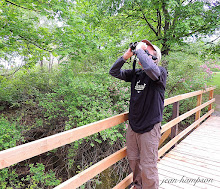
For the survey, only one person can find, identify, and count the birds. That was Jean's job. I was the assistant, the lucky one to carry the broadcast unit down the slope to the creek's edge and document information. More than one observer would bias the results.

What did we find during our first visit? No focal species were seen or heard. Secondary species mapped included Red-winged Blackbirds, Baltimore Oriole, Great Blue Heron, a pair of Wood Ducks (FOY) and a Ruby-throated Hummingbird. At first it appeared the hummingbird would be recorded as a fly-through but it came to a rest near the focal point. It seemed it was conducting it's own survey as it sat perched on a small branch above the creek. A Mourning Dove was recorded on the Outside/Fly-throughs list.


The weather was warmer and there was no cloud cover during the second visit.


Red-winged Blackbirds, Great Blue Herons (3) and a perched Belted Kingfisher were observed within the survey area. Barn Swallow, Tree Swallow and American Goldfinch were fly-throughs.


No ticks on the focal species chart. Would a third time be a charm?

Though it was not essential, we conducted a third survey of the Barnesdale Marsh on Canada Day (July 1). One last attempt to record a rail or bittern but the calls broadcasting from our boom box were unanswered.


Since 2006, Jean and I have birded this little area adjacent to a residential neighbourhood in Port Dalhousie a number of times between the months of March and October. Despite not finding any focal species during the MMP or on my eBird lists for this spot, we will return to Richardson's Creek for the program in 2012. As stated in the participant's handbook, surveys of small marshes are needed to help determine the effects of marsh size on species diversity and abundance. If we can observe this many turtles in such a tiny marsh, perhaps there's still hope for a bittern sighting.


Saturday, October 15, 2011

A Bird to be Thankful For

Though I prefer (or is it that I feel compelled) to post my birding adventures in order, this one was too exciting to hold off for a few weeks. Tales of firsts of the year and lifers found between June and October will appear in future posts.  

Jean and I had the Thanksgiving Day weekend pretty well set before it started. On the Saturday we would attend the OFO Hamilton/Burlington trip, assist John Black with the Fall Buffalo Ornithological Society (BOS) count on Sunday and relax and possibly do some yard work before going to my brother-in-law's for dinner on the holiday Monday. All it took was one e-mail and plans for Monday were suddenly changed.

It was Sunday evening when I became aware that there was a possible juvenile Purple Gallinule in St. Catharines. Not only was the marshbird within minutes of my home, it was near the area Jean and I had birded with our fellow Niagara birders earlier in the day. For part of the morning, we counted birds on the west pier and in Malcomson Eco Park in Port Weller for the BOS Fall count. At 10:00 AM,  Jean and I left the group so we could start on our assigned area within John's section. The lucky few that stayed as a group would find a juvenile Purple Gallinule at a pond on the east pier in Port Weller while Jean and I were walking the trails in Firemen's Park.

An additional posting Monday morning had Jean and I heading for Port Weller for an early afternoon tick for our Ontario list. Our lifer Purple Gallinule was observed in the East River Pool at St. Marks NWR while on vacation in the panhandle of Florida in June of 2007. Though the breeding range of the Purple Gallinule reaches the gulf coast of the United States from the tropics, they do stray northward quite regularly.

Walking along the seaway road towards the pond, we met inquisitive dog walkers and birders that were successful in their hunt. We took the advice of the reports and headed for the east side of the pond, meeting additional birders, including Paula, a member of the group that observed the bird on Sunday morning. The bird was still there and had been seen standing on and near an object sticking out of the water. The juvenile gallinule was hidden when we arrived but it eventually made a short appearance before disappearing in the reeds.


A few more birders arrived, some choosing to pass on turkey dinner with their family so they could observe a tropical mashbird in southern Ontario. The bird was partially seen as it moved through the reeds. A few chose to try and observe it from the west side of the pond and were rewarded with great views. At first, I stood my ground on the east side with hopes that the gallinule would walk back to the object sticking out of the water. A birder from Oakville indicated he was seeing the gallinule quite easily, so Jean,myself and Hamilton birder, Cheryl Edgecombe, quickly walked over to the west side.


The wait was not long. The Purple Gallinule soon emerged from the Phragmites and cattails, allowing Jean and I excellent views of the reported bird. The lighting was significantly better on the west side and Jean took out her Nikon Coolpix and started snapping digiscoped images.


The gallinule repeatedly flashed its all-white undertail coverts. This was an important observation. If there was a sign of a black line in the undertail coverts, then we were looking at a Common Gallinule (formerly know as a Common Moorhen). Neither Jean or I could see any black in the undertail coverts.


The body of the bird was buffy-brown and there was hints of green on its back and wings. This was definitely a juvenile Purple Gallinule.


Number 257 for the Ontario list and number 204 for the year.


This will be the fourteenth observation of the species in Ontario and only the fourth in Niagara. The last record of Porphyrio martinica in Niagara was in October of 1962 (Black and Roy 2010).


As people left, more arrived. My cycling friend Dave (an occasional contributor of images to my blog) began snapping photos with his digital SLR as we helped him, Mike, and our fellow OFO members, Norm and Marilyn get on the bird. I wonder if we'll run into the same group of friends when we go see The Big Year?


During the 1.5 hours Jean and I were at the pond, we had some great unobstructed views of the Purple Gallinule. It certainly removed the sting of missing the observation during the BOS count. Filled with gallinule, we still had plenty of time to arrive at my brother-in-law's for Thanskgiving dinner and fill ourselves with turkey.


Monday, October 10, 2011

Alvar Birding

May 29

Alvars are a unique habitat found over a base of limestone or dolostone and are limited to areas in northern Europe and the Great Lakes Region of North America. Luckily for me, I live between two Great Lakes, which allows me easy access to an alvar that is designated an Important Birding Area by Birdlife International.

The Carden Alvar is located northeast of Toronto and can be easily reached in 2.5-3 hours from the Niagara Region. Last year's trip was the first visit for Jean and I and we added 5 lifers, including the endangered Loggerhead Shrike, to our life list. This year I was looking to add a number of species to the year list and if a couple of lifers were collected in the hunt, all the better.


We stayed overnight in Orillia and Saturday evening was spent birding along a paved trail that took us to the Narrows and a municipal park by Portage Bay. We added 16 species, ranging from the ubiquitous Rock Pigeon to a colourful male American Redstart, to the Simcoe County list. After ticking an Eastern Meadowlark on our way to Kirkfield the next morning, the county list stands at 31 species.


We met trip leaders Jean Iron and Ron Tozer in a Kirkfield school-yard and scanned for birds while waiting for the rest of the group to arrive.Though species were limited, Jean and I added Cedar Waxwing to the year list. You never know how many members will attend a field trip. The OFO Carden Alvar trip is a popular one but it appeared the forecasted rain discouraged quite a few from joining us for a great day of birding. There was certainly going to be a lot more elbow room along Wylie Road this year, our small party of birders was less than half the size of last year's trip.

A light rain was falling as we strolled north along the gravel road. If I didn't get my target species the first attempt, I could try again after birding the Sedge Wren Marsh.  Jean and I have found Grasshopper Sparrow and a surprise lifer Clay-colored Sparrow in the Niagara Region but these Emberizid ticks are more easily found in the grassland and scrubland of the Carden Alvar. Four species of Emberizid were singing as we walked along Wylie road and we had some good views of Grasshopper and Clay-colored Sparrows through the scope at Windmill Ranch.

An Upland Sandpiper stood atop a lichen encrusted rock.


Before reaching the marsh, we ticked two more firsts of the year, Brown Thrasher and Golden-winged Warbler. Like last year, the male Vermivora chrysoptera was seen singing from an open perch.

Once in the Sedge Wren Marsh we listened for the calls of wrens, bitterns, sora, rails and flycatchers. Last year, we observed a lifer Alder Flycatcher and Sedge Wren and ticked American Bittern and Marsh Wren for the 2010 provincial list. This year, these species were repeated. American Bittern were calling and we had a quick view of one flying low before it dropped out of sight. Sedge Wren and Marsh Wren were heard singing but stayed hidden and Jean Iron picked out the call of an Alder Flycatcher which we spotted perched on a branch. Without its call, it would just be an Empidonax sp. The wichity wichity wichity song of the Common Yellowthroat and the descending whinny of a Sora were also heard. As we left the marsh, one last FOY for Jean and I, a Black-billed Cuckoo. This species avoided my checklists last year and it just might help me get 208+ this year.

Returning along Wylie Road, we spotted additional Brown Thrasher and a Wilson's Snipe (FOY), a species missed in April during the OFO trip in Algonquin Provincial Park.

A few more Upland Sandpiper were found.


Including this one that Jean photographed from the car as we drove by the fence post.


No Loggerhead Shrikes were observed while hiking along Wylie Road but there was still the possibility of observing the masked endangered species during our visit to the Carden Alvar. At the Great Blue Heron rookery (seen from Shrike Road), we observed a rare Blanding's Turtle sunning itself on a log.


Travelling north towards McNamee Road, we stopped to scan the scrubland for shrike. Though it was distant, we got on a Loggerhead Shrike using the scope. We found a second Loggerhead Shrike and an Upland Sandpiper while scanning more scrubland on McNamee Road.

At the Cameron Ranch on Kirkfield Road 6, a third shrike for the day, Wilson's Snipe and Brown Thrasher.


In 2003, the Nature Conservancy of Canada acquired the Cameron Ranch and the 1161 hectare ( 2869 acres) property will become part of a new Carden Alvar Provincial Park.


We then crossed the causeway at Canal Lake and observed an Osprey in its nest on one of the platforms. No Common Loon in the small body of water near the causeway this year but a little further down Centennial Parkway, we stopped near the small marsh to look for bitterns and rails.


Jean Iron played the song of a Least Bittern and the coo coo coo brought out the inquisitive lifer (#307) for my wife and I. We studied the Least Bittern through our scope as it stood grasping a reed in each claw in order to support itself above the water. Once we had taken in all of the bittern's field markings, it was time to capture a digiscoped image of the very photogenic pose.


Yes, it bolted! The only photographic evidence we have is a small brown blob flying above the marsh.


We continued the trip south of Kawartha Road 48 to look for Sora, rails, bitterns, wrens and waterfowl in the Prospect Marsh.

In one section of the marsh, Jean and I ticked Blue-winged Teal and Pied-billed Grebe for the year list.


At our second stop, the spot where we observed our lifer Virginia Rail on our first visit to the Carden Alvar, we observed a Virginia Rail (FOY) and a Common Gallinule (FOY). The last time we observed a Gallinula sp in Ontario (April 2007), it was known as a Common Moorhen. This was a welcomed tick. It had been absent for 3 long years. Now, if I ever find myself in Europe, thanks to a split into Old World and New World species, I can once again add Common Moorhen to my life list.

Further down Prospect Road, the group found Clay-colored Sparrow sitting low in the scrubby brush and we had some great views of a second Virginia Rail.


The trip was nearing completion when Jean and I ticked one more first of the year. This time, the call of a Empidonax species belonged to a Willow Flycatcher.

After a day of birding in the Carden Alvar, 20 species were added to the Ontario year list and another month of birding came to a close. Ticking a lifer Least Bittern, Common Moor, errr I mean, Common Gallinule, both the Alder and Willow Flycatcher as well as the target species will certainly help to obtain a second 200+ year. The next few weeks would be considerably slower and that was OK with me. Before heading up to Sudbury in July for a chance to tick warblers missed during their migration through Niagara, Jean and I would do some Marsh Monitoring in St. Catharines.


Tuesday, September 27, 2011

May Birding: Long Weekend

The Victoria Day weekend, aka "The May Two-Four", was established as a legal holiday in Canada after the death of Queen Victoria. In my much younger years, I would watch the firework displays on a Sunday or Monday evening, but now that I'm a birder, I take the opportunity to add an extra day of birding to my weekend. There were still warblers to be found, including another attempt at the Hoodie. Can Hooded Warblers be called "Hoodies"?

Saturday May 21

Jean and returned to Malcomson Eco Park in St. Catharines. Something was odd though. It was sunny.
The precipitation encountered the last three weekends was nowhere to be seen.

Nashville and Yellow Warblers were observed, but still no Blue-winged, Blackburnian, Cape May or Canada (all species observed last year) for the 2011 list. We did get one treat though. A FOY Yellow-billed Cuckoo sat in a tree, very close to the trail. We've seen one in Ontario every year since we started birding and I would have to say this was the best observation of the bunch. It was very close and the view remained unobstructed as the cuckoo moved slowly from tree to tree.   


Sunday May 22

The sunny weather continued the next day and we went to Niagara Shores in Niagara-on-the-Lake for an easy tick. As expected, hundreds and hundreds of Bank Swallows were excavating nesting cavities along the Lake Ontario shoreline.


The fence line at the eastern edge of the conservation area is one of my favourite spots to look for migrants in the Spring. You may pick up the occasional tick or two (the eight-legged variety) while walking along this path but chances are good that flycatchers, vireos, thrushes and warblers will be found here or in the neighbouring property (formerly owned by the Department of Defence).


Warblers seen this day included, Black-and-white, American Redstart, Magnolia, Yellow, Chestnut-sided and Wilson's. Blue-winged are not easily found but the absence of Blackburnian from our year list was starting to annoy me. Before leaving Niagara Shores we added Gray-cheeked Thrush to the year list. This was only our second observation of this thrush species and a first for our Niagara list.
    

Monday May 23

For the holiday Monday, Jean and I headed to the southern end of the peninsula for a second attempt at observing a lifer Hooded Warbler. It could be a firecracker day. There was the possibility of an additional lifer in Fonthill. A Greater White-fronted Goose was reported on ontbirds. It seemed slightly odd that this species would be at the St John's Conservation Area trout pond but I was not about to pass by the area without a quick look.

At first, all we could see were Canada Geese.


We walked along the path an spotted the reported goose standing near the edge of the pond.


Jean' suspicions were confirmed. It was a domestic Graylag. Though the goose had a slight white band at the base of its bill, it lacked the black belly markings found on the Greater White-fronted Goose.


A variety of birds can be found while hiking the trails in the conservation area but we returned to the parking lot after walking around the pond and heard a song Jean and I suspected was a Pine Warbler. The song was coming from a cluster of pines at the top of a slope, above the parking lot. What else could it be? It continued to sing but the warbler did not make an appearance. We've seen this species a few times, so hearing its song without seeing it was good enough for a tick.

Once at our destination, we walked along the gravel road to the spot where we had heard the Hooded Warbler the previous weekend. It did not take long for us to hear the song again and this time, we both got on the bird as it moved above the Skunk Cabbage. The lifer Hooded Warbler moved towards us and placed itself on a branch hanging over the road. Its yellow face, black hood and bib and yellow underparts were easily observed as it sang from its perch. An excellent view for a lifer tick! A female Hooded Warbler appeared and the pair moved on. 

After viewing the Hooded Warbler pair, we stopped at a couple of spots in Fort Erie and found nothing new for the year until we started our drive back along the Niagara Parkway.


7 Great Egrets (FOY) and 2 Great Blue Herons were hunting in Frenchman's Creek. Fish travelling upstream from the Niagara River did not stand a chance.


Overall, it was a great weekend of birding. The Hooded Warbler was the third lifer of the year and I expect them to occur less often, now that we are above 300. The days of adding 10 or more species at a time in southern Ontario are gone. Until Jean and I can plan a road trip out of the province, we'll continue to peck away at the lifers while birding in the Niagara Region and on OFO trips. Last year we picked up 5 lifers while on the OFO Carden Alvar trip. I was looking to repeat these species for this year's list on May 29. Adding a lifer or two would be an added bonus.


Sunday, September 11, 2011

Big Nickel Birding: A Sudbury Sunday Night

July 17

It was our first evening in the region of Greater Sudbury, not quite as exciting as a Sudbury Saturday Night but it would do just fine. After dinner, my brother returned to work and he suggested Jean and I check out a neighbourhood trail for an evening stroll. The Robinson Lake Trail is an easy one kilometre of gravel path and boardwalk.

We accessed the trail from a municipal park and ticked Cedar Waxwing, American Goldfinch and Song Sparrow as we walked towards the boardwalk.


Common Yellowthroat were calling from all directions in the marsh and a family of Mallards had found a spot for the night in the stream that empties into Robinson Lake. Yes, I was ticking birds for a new county list. Mallards, Double-crested cormorants and Ring-billed Gulls were not overlooked. 


Walking through the stand of birch, I hoped to find a more worthy tick. No FOY warblers or a much sought after Pileated , but the Northern Flicker and Hairy Woodpeckers (2) were a nice accompaniment to the robins spotted in the small patch of wild in northern suburbia.  


After a couple of incidentals and some birding on a Sudbury Sunday Night, the county list stood at 13 species. Jean and I would have 3 full days available for Big Nickel Birding so adding birds to the list was not going to be a problem. Finding the target species was another matter. 


Thursday, September 8, 2011

May Birding:2011 May BOS Count

So I find myself obtaining more tales but I'm slow to post them. After spending a few days at a cottage with family and friends, I now have some Lake Huron tales to share. For the time being, I'll continue with the month of May and my visit to Sudbury.

May 15

It was time for the May BOS count. The previous day, we added 17 species to the 2011 Ontario list and came close to ticking a lifer Hooded Warbler while birding spots along the Lake Erie shoreline. After a couple of slow weekends at Malcomson Park, it felt good to finally get out of our birding slump.

An overnight rain continued at the start of our count while birding the Port Weller West Pier with Kayo, Dan and Brian.


We spent almost two hours scanning the brush on the pier and observed a total of 36 species. Warblers added to the year list included, Common Yellowthroat, Magnolia, Blackpoll, Wilson's, Orange-crowned and Northern Waterthrush. Dan pointed out the songs of an Ovenbird and Lincoln's Sparrow. Two species needed for my life list. The warbler was hidden deep in the brush and we had a quick glimpse of the sparrow but it was nowhere near enough to observe its field markings. No lifer ticks if they're not seen.

Before leaving for our assigned area in Section 2 of the BOS count, Jean and I added Veery, Swamp Sparrow and Least Flycatcher to the year list. The weekend haul was looking good.


The rest of our count was a mixture of travelling along roads and walking through parks within the the city of Niagara Falls. We found a Spotted Sandpiper while driving along a rural road on the Niagara Escarpment and then moved on to Firemen's Park. The wind storm that occurred in late April uprooted a few trees on the Bruce Trail.


Even though a tree fell as we approached the wooded area of the park, we ventured onto the trail, determined to find additional FOY warblers.


Birds of interest found in the Niagara Falls park included, Baltimore Oriole, Hermit Thrush, Magnolia Warbler (the only warbler species found in the park during our hike), Eastern Bluebird, Rose-breasted Grosbeak and a first-of-the-year Ruby-throated Hummingbird.

Before starting our drive along the Niagara Parkway towards the Falls, Jean and I usually check a stretch of road that runs along the base of the escarpment. From the road-side, we observed Barn Swallows and Northern Rough-winged Swallows (FOY) flying over a small pond.


We continued up the road and found a few of the usual species, but upon reaching the dead end, we spotted an unusual bird in the vineyard. The bird was almost entirely white! Its head was speckled grey, the beak yellow and from the shape of the body, it appeared to be a species of thrush.


It was a leucistic American Robin. Leucism (caused by a genetic mutation) occurs when the pigment is not properly deposited in the feathers. Since the beak and legs had colour, this was not an albino bird. Though it was cool to see our first leucistic bird, it still only counts as an American Robin at the end of the day. Time to move on.


From Queenston to Chippawa, we travelled along the Niagara Parkway with stops at the Lilac garden and the arboretum at the Niagara Parks Horticultural Gardens.


No more firsts-of the year until the bridge in Chippawa. It's a reliable spot for Cliff Swallows and after standing in the rain for what seemed a rather long 10 minutes, I spotted a Cliff Swallow for the 2011 year list amongst a few Barn and Northern Rough-winged Swallows. I needed that after finding a disappointing number of species at the Peter Street feeders. The rural roads near the Welland River did not produce much either. Once back on the QEW, we soon concluded another BOS count.

The third weekend in May turned out to be very productive. No lifers, but a total of 30 species for our year list. The next weekend in May was the Victoria Day weekend. An extra day to find FOY's in the Niagara Region and another chance at ticking a lifer Hooded Warbler. My glass was starting to look half-full again.